
The short answer
No, a commercial or warehouse overhead door is not just a bigger version of your garage door. The steel is heavier, the spring and track systems are rated for far more cycles per day, the opener has more muscle and more safety features, and the maintenance schedule is more frequent and more technical. If you've got a detached workshop, a small retail space, or a home business with a roll-up door out back, treating it like your residential garage door is how small problems turn into stuck-open, stuck-closed, or safety emergencies.
What actually makes commercial doors different
Heavier gauge steel and reinforced panels
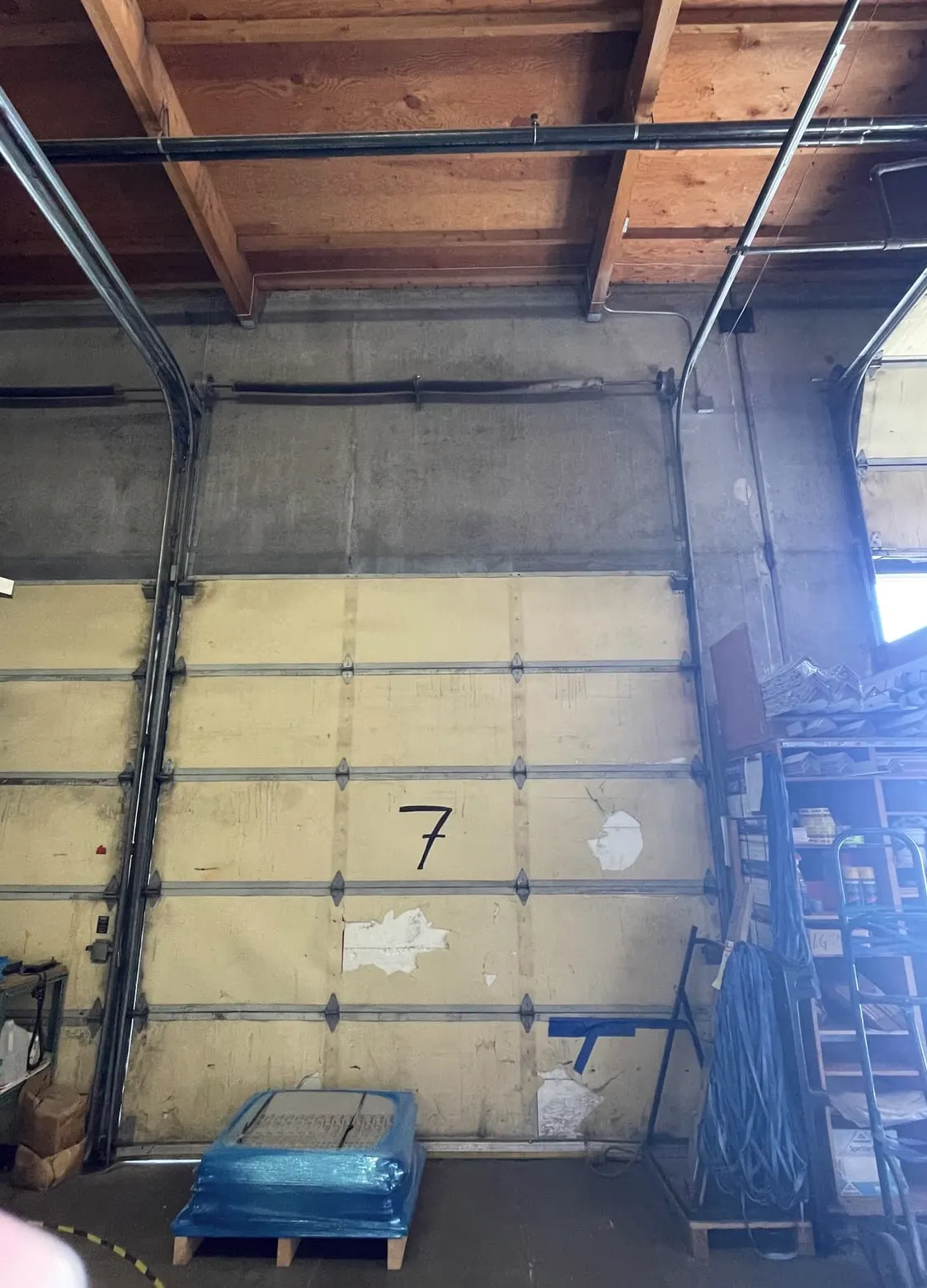
Residential doors are typically 24–27 gauge steel, built for a door that opens a handful of times a day. Commercial and warehouse doors run 20–24 gauge or thicker, often with reinforced ribs or struts, because they're expected to take daily impact from forklifts, delivery carts, and foot traffic near the opening.
Higher-cycle springs and track hardware
A residential torsion spring is usually rated for around 10,000 cycles — fine for a door that opens twice a day. Commercial doors get high-cycle springs rated for 20,000, 50,000, even 100,000+ cycles, because some of these doors open and close dozens of times daily. The rollers, hinges, and track brackets are also built heavier to handle that traffic without the slop and wobble you'd start to see on residential-grade parts under the same workload.
Bigger, smarter openers
A 1/2 HP residential opener isn't going to cut it on a commercial door. These openers run on higher horsepower, often with chain hoist or jackshaft operators, and they come with additional safety requirements — photo-eye sensors, edge sensors, and sometimes monitored access control — because the usage pattern and the people around these doors (employees, customers, delivery drivers) are different from a family pulling in and out of a driveway.
Different failure points
Residential doors usually fail at the spring or the opener. Commercial doors fail there too, but you also see more wear at the bottom seal (constant traffic and loading dock contact), the track alignment (forklifts clip the jambs more than cars do), and the weatherstripping, which takes a beating from being opened for longer stretches while goods move in and out.
Why the maintenance schedule has to be different too
This is really the heart of the argument. A residential door can often go a year between a real inspection and still be fine. A commercial door working multiple cycles a day can't wait that long — worn parts show up faster simply because the door is doing more work.
- Lubrication more often. High-cycle springs, rollers, and hinges need lubrication on a tighter schedule than a residential door, especially heading into the humid season when moisture speeds up corrosion on hardware that's already working harder.
- Cycle-based inspections, not just calendar-based ones. A door used 20 times a day should be checked more like a piece of equipment with a maintenance interval than a household fixture you glance at occasionally.
- Safety sensor checks. Photo eyes and edge sensors on commercial doors protect people as much as property. A sensor that's drifted out of alignment is a bigger liability on a door near employees and customers than on a residential door only your family uses.
- Seal and weatherstripping replacement. Doors that stay open longer during loading let in more weather — a real issue with the heavy rain and occasional coastal storms this area sees, and again in winter when cold air pouring through a worn seal can affect anything stored or sold inside.
Where local weather and older buildings complicate things
This area's mix of older outbuildings and newer construction means a lot of commercial-style doors are sitting on structures that weren't necessarily built with that door's weight and cycle count in mind. Icy winters can freeze bottom seals to the slab on doors that sit open and closed all day, and humid summers accelerate rust on hardware that's already working overtime. If the building is older, the track mounting and header reinforcement are worth a second look — a heavier commercial door puts more stress on framing than the residential door it may have replaced.
When to call Upper Marlboro Door & Opener
If you're running a commercial or warehouse door that's cycling multiple times a day, showing uneven wear, drifting out of track alignment, or just hasn't had a real inspection in a while, that's the time to get it looked at rather than waiting for it to fail mid-shift. We handle commercial garage door services for properties throughout Upper Marlboro, Bowie, Largo, Brandywine, Clinton, Fort Washington, Mitchellville, and Forestville, including high-cycle spring replacement and full garage door maintenance visits that check sensors, seals, and hardware wear before they become a stuck door or a safety issue.
If you've got a commercial or warehouse door — or you're trying to settle this exact argument at home — give Upper Marlboro Door & Opener a call. We'll tell you straight what your door needs and what it doesn't.